22 Apr 2026
Set and don’t forget: the case for a local government levy on properties with OWMS in Victoria
RMCG Associate Duncan Wallis examines the regulation of onsite wastewater management systems (OWMS), and how gaps in knowledge and funding pose environmental and public health risks
The problem
In larger towns and cities, water corporations manage sewerage systems that service households. But outside these areas, households and businesses rely on onsite wastewater management systems (OWMS), which are no longer just “septic tanks,” but increasingly advanced treatment and reuse systems.
The risks OWMS pose to the environment and to public health at a local level are real. Children inadvertently contacting effluent when playing in their backyard, for example, or sensitive environments becoming contaminated through uncontrolled discharge of partially treated effluent, especially where the density of OWMS is high.
Despite landowners and occupants being responsible for the management of their individual OWMS, many remain ignorant of even the most basic information regarding their waste management. For example, they may not even know whether their property is connected to sewerage, or whether they rely on an OWMS.
Right now, the regulation of OWMS largely falls to councils and this is often poorly funded. It’s not unusual for wastewaster management to be lumped in with food safety and the like, and inevitably taking a backseat.
Councils have statutory obligations to oversee the management and compliance of existing OWMS within their Local Government Area, as well as administering processes for future OWMS installations in accordance with the Environment Protection Act 2017. Environmental regulations and legislation explicitly outline responsibilities and expectations for individual and council management of OWMS.
Managing the existing “fleet” of OWMS requires council resources to assist the public with technical matters, respond to complaints and issue permits for the installation and alteration of OWMS. The reality is that right now, many councils do not know where all their existing OWMS are located, and often are without a reliable or complete database.
Managing the creation of future OWMS also requires environmental health resources to co-ordinate decisions and approvals with Council’s town planning, building and engineering departments, as well as the relevant water corporation. Sewerage systems cover only a tiny fraction of the private land in regional local government areas. Wastewater is often not considered early in the planning processes.
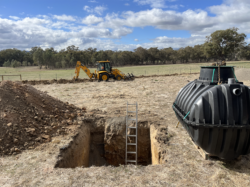
It’s not as simple as increasing the area supported by sewerage systems. Water corporations are understandably reluctant to provide backlog sewerage services to unsewered small towns and districts. They are expensive to build and run, and oftentimes landowners are reluctant to join reticulated schemes because of the cost to connect and past investment in their own OWMS. Important and timely decisions need to be made by water corporations and councils as part of the land planning and development processes.
With limited resources dedicated to sewerage planning and OWMS permit applications, there is an ever-present risk that inappropriate subdivisions and OWMS will slip through the system.
The case for a levy
What stops agencies who oversee unsewered developments from instating a small charge per year?
After all, it’s already standard practice across many essential council services. Those of us who receive a bin service are used to council charges for that service. Those who don’t use a bin service, don’t see that charge.
Similarly, households connected to the sewer are paying sewerage charges to their water corporation, while unsewered houses (those with OWMS) do not pay these rates.
OWMS management is currently funded from the general municipal rate. The cost is therefore spread across all rate payers, including those without OWMS, and has to compete with funding for the wide range of other council services.
By imposing an OWMS levy, councils would be provided with a revenue stream that could be dedicated to overseeing OWMS.
The key improvements that could be implemented if councils charged an OWMS levy might be:
- Pro-active risk assessment and audit of existing OWMS
- Anticipating development trends and helping to plan for orderly sewerage and OWMS infrastructure development
- Thinking deeply about the non-standard options for providing reticulated wastewater services to small communities where sewerage is not available, but existing OWMS are at risk of causing harm to the environment or human health.
A levy would also send a clear message to OWMS owners that these systems are not ‘set and forget’. There are responsibilities associated with managing them, and Council is available to help meet these responsibilities.
Straightforward improvements to existing data systems would be required for the levy to operate, and that system would provide the basis of an OWMS asset register that could be developed and tailored to suit the local conditions and the risk.
The proposal
What if councils imposed a levy of ~$50 per year per onsite system? It could be administered on the standard rates notice, in much the same manner as councils already charge for garbage services.
It’s also a case of fairness. Landowners, who pay the water corporation for sewerage rates, are being charged twice.
Perhaps Victorian councils, DEECA and water corporations should start the conversation with their communities. It’s clear that non-sewerage wastewater could, and should, be better managed. It’s also clear that councils want to make better efforts to manage non-sewerage wastewater, but many currently lack sufficient resources to do so.
More information
RMCG is here to assist government, water corporations, industry and community to plan and implement effective water management solutions. Find out more about our work in Water and Resource Recovery.